Chronologies
-
A History of Humankind
400000 BC – present 185 entries 70 pictures 12.7 MB
From the first Homo sapiens 300,000 years ago to the present day on one strip. Eight eras give the big picture: the Old Stone Age, the Neolithic, the Bronze and Iron Ages, antiquity, the Middle Ages, the modern age and our own time. Below the axis run the bars of civilisations, empires and wars — and the lives of four people everyone knows: Alexander the Great, Genghis Khan, Leonardo and Napoleon. A card's background is its part of the world — Europe, the Near East, Egypt and Africa, Asia, the Americas, Russia — or science, religion, the whole world; the tag names it too. The colour of a dot is how much an event matters, as a rainbow: red — turning points of all history, orange — the main milestones, yellow — notable, green — ordinary, blue — details seen only up close. The strip is to scale: the Stone Age takes up nearly all of it, and history proper — the last five thousand years — opens as you zoom in.
Download .timeline updated 2026-10-17
-
Great Scientific Discoveries
1800 BC – present 202 entries 49 pictures 9.2 MB
The great discoveries of science on one strip, from Babylonian tablets with Pythagorean triples to the first image of a black hole and gene editing. Eight eras give the big picture: the science of the ancient world, the Middle Ages of Baghdad, India and China, the Scientific Revolution, the Enlightenment, the classical nineteenth century, the age of the atom and relativity, Big Science after 1945 and the twenty-first century. Below the axis run bars: schools and academies, observatories, expeditions and great projects — the Manhattan Project, the Human Genome Project, the Large Hadron Collider, space telescopes — theories that reigned for centuries before they fell, and the lives of two people everyone knows: Isaac Newton and Albert Einstein. A card's background is its field — mathematics, astronomy and cosmology, physics, chemistry, biology, genetics and molecular biology, earth sciences, science at large; the tag names it too. The colour of a dot is how much a discovery matters, as a rainbow: red — turning points of all science, orange — the main milestones, yellow — notable, green — ordinary, blue — details seen only up close. Medicine and inventions are left to other chronologies: here is what was found out about the world. In the background plays Bach's Prelude in C major — music of pure proportion, recorded by Kimiko Ishizaka.
Download .timeline updated 2026-10-17
-
Space Exploration
1865 – present 209 entries 53 pictures 7.7 MB
The road to space on one strip, from Jules Verne's cannon and Tsiolkovsky's equation to reusable boosters, Webb and Artemis. Seven eras give the big picture: dreamers and pioneers, the rockets of war, the space race, stations and probes, the Shuttle and Mir, cooperation on the ISS and the new space age of private companies, China and India. Below the axis run bars: programmes and spacecraft — Vostok, Apollo, Soyuz, Salyut, Mir, the Shuttle, the ISS, Voyager, Hubble, Tiangong, Artemis — space agencies and companies, the Cold War and the space race, and the lives of two people: Sergei Korolev, the Chief Designer, and Yuri Gagarin. A card's background is who made it happen: the pioneers of rocketry, the USSR and Russia, the USA, Europe, China, India and Japan, private companies, or international projects; the tag names it too. The colour of a dot is how much an event matters, as a rainbow: red — turning points of the whole story, orange — the main milestones, yellow — notable, green — ordinary, blue — details seen only up close. In the background plays Johann Strauss's "The Blue Danube", the waltz to which a spaceship docks with a station in "2001: A Space Odyssey".
Download .timeline updated 2026-10-17
-
A History of Programming Languages
1804 – present 202 entries 32 pictures 3 MB
Programming languages on one timeline, from Jacquard's punched cards and Babbage's Analytical Engine to transformers and AI agents that write code themselves. Seven eras give the big picture: mechanical computing, the first computers, mainframes, personal computers, the web, smartphones and the cloud, the age of AI. Assembly, C, C++, Java, C#, Python, JavaScript, TypeScript, Rust and Dart are followed in detail, as are the branches "AI and neural networks" and "OS and tools" (Unix, the internet, Linux, Git); beside them, other notable languages, milestones of computers and events of world history for background. Below the axis run bars: the life of each language, the AI winters, the wars of the age and the lives of two people without whom this strip would not exist: Alan Turing and Linus Torvalds. A card's background is its branch: each language has its colour, as do AI, tools, other languages, computers and world history; the tag names it too. The colour of a dot is how much an event matters, as a rainbow: red — turning points of the whole story, orange — the main milestones, yellow — notable, green — ordinary, blue — details seen only up close. In the background plays Grieg's "In the Hall of the Mountain King" on the ZX Spectrum's one-bit beeper, as in Manic Miner (1983).
Download .timeline updated 2026-10-17
-
Technologies of Everyday Life
1800 – present 200 entries 53 pictures 6.6 MB
The technologies of everyday life on one strip, from Volta's battery and the first photograph to the smartphone, streaming and chatbots: how pictures, sound, light, warmth and cold, speed and conversation moved into the home and then into the pocket. Seven eras give the big picture: steam, gaslight and the first pictures; the age of invention; electricity comes home; depression, war and the radio set; the consumer boom; digital comes home; the world in a pocket. Below the axis run bars: the lives of technologies — the daguerreotype, film photography, the telegram, the landline, the LP, the VHS era, the tube television, the incandescent bulb, the Model T, Napster, the iPod — and the life of one man, Thomas Edison. A card's background is its area of home life: photo and cinema, sound and music, radio and television, telegraph and telephone, home appliances, transport, computers and gadgets, the internet and social media, light and energy, things and materials; the tag names it too, and a bar takes the same colour. The colour of a dot is how much an event matters, as a rainbow: red — turning points of the whole story, orange — the main milestones, yellow — notable, green — ordinary, blue — details seen only up close. In the background plays Scott Joplin's "Maple Leaf Rag", as the composer himself recorded it on a player-piano roll in 1916.
Download .timeline updated 2026-10-17
-
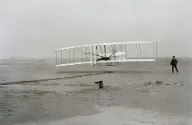
A History of Aviation
1485 – present 194 entries 56 pictures 7.5 MB
Flight on one strip, from Leonardo's sketches of flying machines and the Montgolfiers' balloon to jumbo jets, drones and a helicopter on Mars. Seven eras give the big picture: dreams of flight, lighter than air, the pioneers, war and the golden age, war and the jet, the jet age, and skies for everyone. Western and Soviet and Russian aviation are followed side by side. Below the axis run bars of wars, aircraft in service, airlines and planemakers — and one pair of people, the Wright brothers. A card's background is its branch: pioneers and inventions, balloons and airships, military aviation, airliners and airlines, records and speed, helicopters, Russia and the USSR, disasters and safety, drones and new technology; the tag names it too. The colour of a dot is how much an event matters, as a rainbow: red — turning points of the whole story, orange — the main milestones, yellow — notable, green — ordinary, blue — details seen only up close. In the background plays Rimsky-Korsakov's "Flight of the Bumblebee", played by a United States Air Force band.
Download .timeline updated 2026-10-17
-
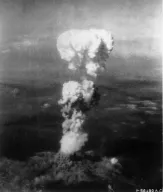
A History of Weapons: from Gunpowder to the Bomb
AD 850 – present 202 entries 58 pictures 9.2 MB
Weapons on one strip, from the Chinese alchemists who stumbled on gunpowder in the ninth century to the Bomb, intercontinental missiles and the drone swarms of today. Ancient arms are left out: the story begins with the fire drug. Eight eras give the big picture: the fire drug in China, cannon and the end of castles, pike and shot, musket and bayonet, rifles, steel and steam, the world wars, the atomic age, and precision and drones. Below the axis run bars of the wars in which weapons changed, of the service lives of famous weapons — the Brown Bess, the Mosin rifle, the Maxim gun, the T-34, the AK, the B-52 — of programmes and treaties in force, and of just two people, Robert Oppenheimer and Mikhail Kalashnikov. A card's background is its branch: gunpowder and artillery, small arms, machine guns, armour and tanks, naval warfare, rockets, aircraft and drones, chemical and incendiary weapons, nuclear weapons, arms control and doctrine; the tag names it too. The colour of a dot is how much an event matters, as a rainbow: red — turning points of the whole story, orange — the main milestones, yellow — notable, green — ordinary, blue — details seen only up close. It is a history, not a manual: numbers are the headline figures historians quote. In the background plays the finale of Tchaikovsky's 1812 Overture — the piece that calls for real cannon — played by the United States Marine Band.
Download .timeline updated 2026-10-17
-
The Bible
4174 BC – present 250 entries 69 pictures 7.7 MB
The story of the Bible and of the Church on one strip of time: from Creation and the patriarchs through the kings of Israel, the exile and the return, to the life of Jesus, the apostles and two thousand years of church history. The eras give the shape at a glance; zoom in for the overlapping lives of the patriarchs, the overlapping reigns of the kings of Judah and Israel with the prophets among them, and the turning points of the Church down to our own day.
Download .timeline updated 2026-10-17
-
A History of Medicine
5000 BC – present 201 entries 54 pictures 9.6 MB
Seven thousand years of healing on one strip, from Neolithic trepanation to mRNA vaccines and the first CRISPR medicines. Eight eras give the big picture: ancient medicine, the Middle Ages, the Renaissance and the new science, the Enlightenment and the clinic, the half-century of anaesthesia, antisepsis and germs, scientific medicine, the age of antibiotics and molecular medicine. Below the axis run bars: the great epidemics from the plague of Athens to COVID-19, the wars that changed medicine, programmes and institutions — the Red Cross, WHO, the eradication of smallpox, the Human Genome Project — and the lives of two people everyone knows: Hippocrates and Louis Pasteur. A card's background is its field — physicians and public health, anatomy and physiology, infections and vaccines, surgery and anaesthesia, drugs, diagnostics and devices, genes and biotechnology, epidemics; the tag names it too. The colour of a dot is how much an event matters, as a rainbow: red — turning points of the whole story, orange — the main milestones, yellow — notable, green — ordinary, blue — details seen only up close. The strip is to scale: antiquity takes up most of it, and modern medicine — the last two centuries — opens as you zoom in. In the background plays the Notturno from the Second String Quartet of Alexander Borodin, a composer who was by profession a chemist and a doctor of medicine.
Download .timeline updated 2026-10-17
-
Tech Giants: A History
1865 – present 182 entries 54 pictures 6.6 MB
Six famous companies on one timeline — IBM, Nokia, Intel, Microsoft, Apple and Google — from a Finnish pulp mill in 1865 to the race for artificial intelligence: how each was founded, its first products, its great successes, its crises and its turns. Seven eras give the big picture: paper, rubber and punched cards; transistors and mainframes; the microprocessor and the first PCs; Wintel and the mobile phone; the internet age; smartphones and the cloud; the age of AI. Below the axis run bars: the life of each company, its key product lines (IBM's mainframes and PCs, Nokia's phones, x86 and Pentium, MS-DOS, Windows, Office, Xbox and Azure, the Mac, NeXT, iPod, iPhone and Apple silicon, Gmail, YouTube and Android), the dot-com bubble and the lives of the two people most closely tied to this story: Steve Jobs and Bill Gates. A card's background is its company — each of the six has its own colour — or one of two lighter strands: other companies (Samsung, Sony, Amazon, Nvidia, OpenAI and more) and technology and the world; the tag names it too. The colour of a dot is how much an event matters, as a rainbow: red — turning points of the whole story, orange — the main milestones, yellow — notable, green — ordinary, blue — details seen only up close. In the background plays Francisco Tárrega's guitar waltz Gran Vals (1902), in a modern recreation by Joni Ikäläinen — the waltz from which Nokia took its famous ringtone.
Download .timeline updated 2026-10-17
-
A History of the USSR
1917–1991 201 entries 61 pictures 9.4 MB
The Soviet Union from the fall of the monarchy in February 1917 to the lowering of the red flag over the Kremlin on 25 December 1991. Eight eras give the big picture: revolution and civil war, NEP, Stalin's Great Break and the 1930s, the Great Patriotic War, late Stalinism, the Thaw, the Brezhnev era and perestroika with the collapse. Below the axis run bars: the terms in power of the seven leaders from Lenin to Gorbachev, the wars, the five-year plans and great projects, the Gulag, the famine and the Great Terror, the Cold War. The story is told as historians tell it — industrialisation, literacy, victory and space flight beside the Red Terror, the famine of 1932–33, the camps, the deportations and Katyn — with numbers where they are established. A card's background is its theme: politics, war, economy, science and space, culture and sport, repression, foreign policy; the tag names it too. The colour of a dot is how much an event matters, as a rainbow: red — turning points of the whole story, orange — the main milestones, yellow — notable, green — ordinary, blue — details seen only up close. In the background plays the swan theme from Tchaikovsky's Swan Lake — the music Soviet television played on the morning of the August coup of 1991 — in a 1933 recording by the London Philharmonic under John Barbirolli.
Download .timeline updated 2026-10-17
-
A History of Modern Russia
1985 – present 199 entries 51 pictures 8.8 MB
Russia from the last years of the Soviet Union to the present day on one strip. Six eras give the big picture: a prelude of perestroika and the end of the USSR, the 1990s, Putin's first terms, the Medvedev–Putin tandem, return and confrontation from 2012, and the full-scale war against Ukraine from 2022. Below the axis run bars: the terms of the presidents from Gorbachev to Putin and of four prime ministers, the Chechen wars, the intervention in Syria and the Russo-Ukrainian war, economic periods from Gaidar's reforms to the sanctions, membership of the Council of Europe and the G8, the New START treaty, the Mir and ISS stations and the pandemic. The story is told as encyclopaedias tell it: with the numbers official bodies and historians give, ranges where they are disputed, the verdicts of international bodies such as the UN General Assembly, and contested claims attributed to whoever makes them. A card's background is its theme: politics, wars and security, economy, foreign policy, society and protest, science and space, culture and sport; the tag names it too. The colour of a dot is how much an event matters, as a rainbow: red — turning points of the whole story, orange — the main milestones, yellow — notable, green — ordinary, blue — details seen only up close. In the background plays the opening Promenade from Mussorgsky's Pictures at an Exhibition, on the piano.
Download .timeline updated 2026-10-17
-
A History of Modern Ukraine
1986 – present 201 entries 60 pictures 8.1 MB
Ukraine from the Chernobyl explosion of April 1986 to the present day. Seven eras give the big picture: late Soviet Ukraine, the first years of independence, the Kuchma decade, the Orange years, the Yanukovych years, the Maidan and the war in the Donbas, and the full-scale war since February 2022. Below the axis run bars: the terms of the six presidents from Kravchuk to Zelensky (and Turchynov's months as acting president) and Tymoshenko's two governments, the karbovanets, nuclear disarmament and the gas transit contracts, the great protests, the Russo-Ukrainian war with the occupation of Crimea, the Donbas war and the full-scale invasion, the Minsk process, martial law, the main battles and the road to the European Union. The story is told as encyclopaedias tell it: facts and figures from official counts, the UN and international courts, with ranges where estimates differ and contested claims attributed to whoever makes them. A card's background is its theme: politics, war and security, economy, foreign policy and Europe, society and protest, culture and sport, science and technology, religion; the tag names it too. The colour of a dot is how much an event matters, as a rainbow: red — turning points of the whole story, orange — the main milestones, yellow — notable, green — ordinary, blue — details seen only up close. In the background plays Mykola Leontovych's "Shchedryk" — the New Year carol the world knows as "Carol of the Bells" — in the 1922 recording by Oleksandr Koshyts's Ukrainian National Chorus.
Download .timeline updated 2026-10-17
Picture libraries
Not a chronology but pictures for any of them: in the editor, “From a library file…”.
-

Stock images
24 pictures 3.2 MB
Pictures for any timeline, in one painted style. Pick one in the editor with “From a library file…”.
Download .timeline updated 2026-10-13